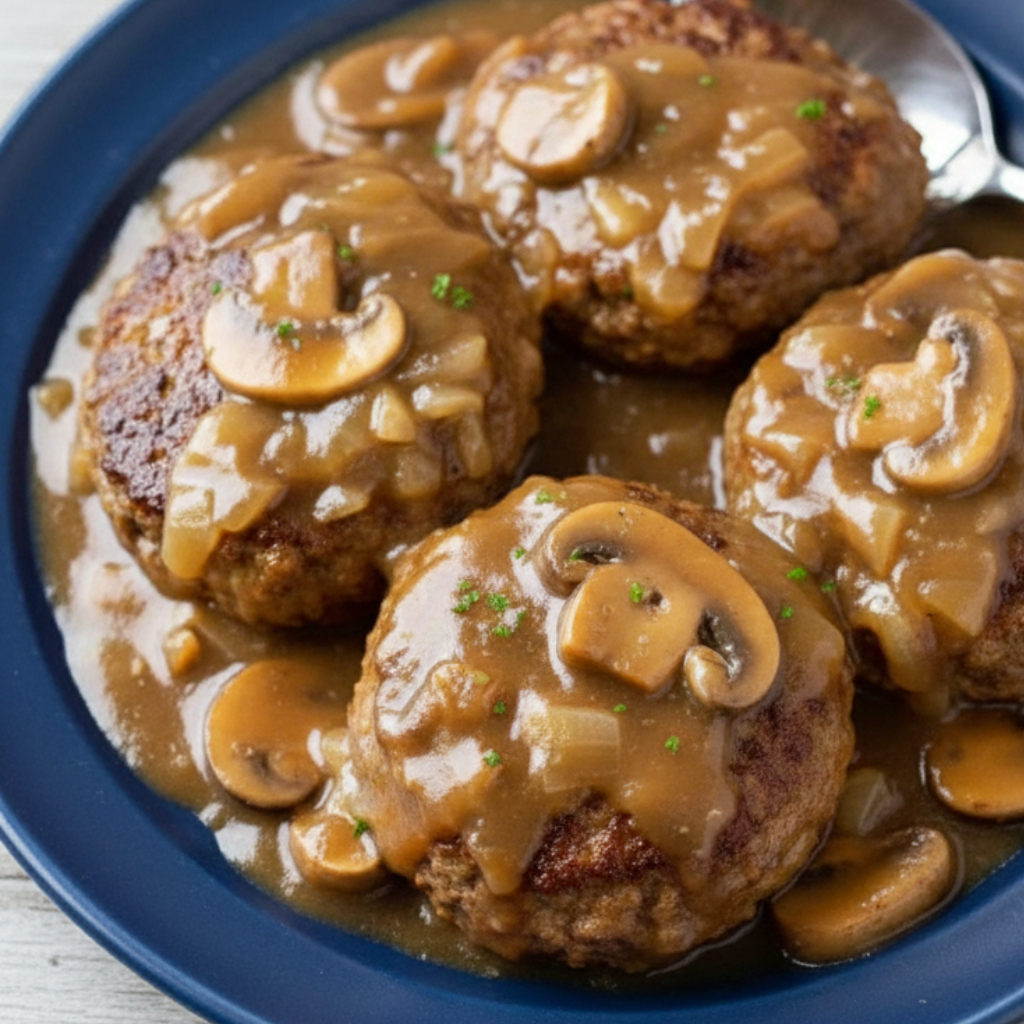
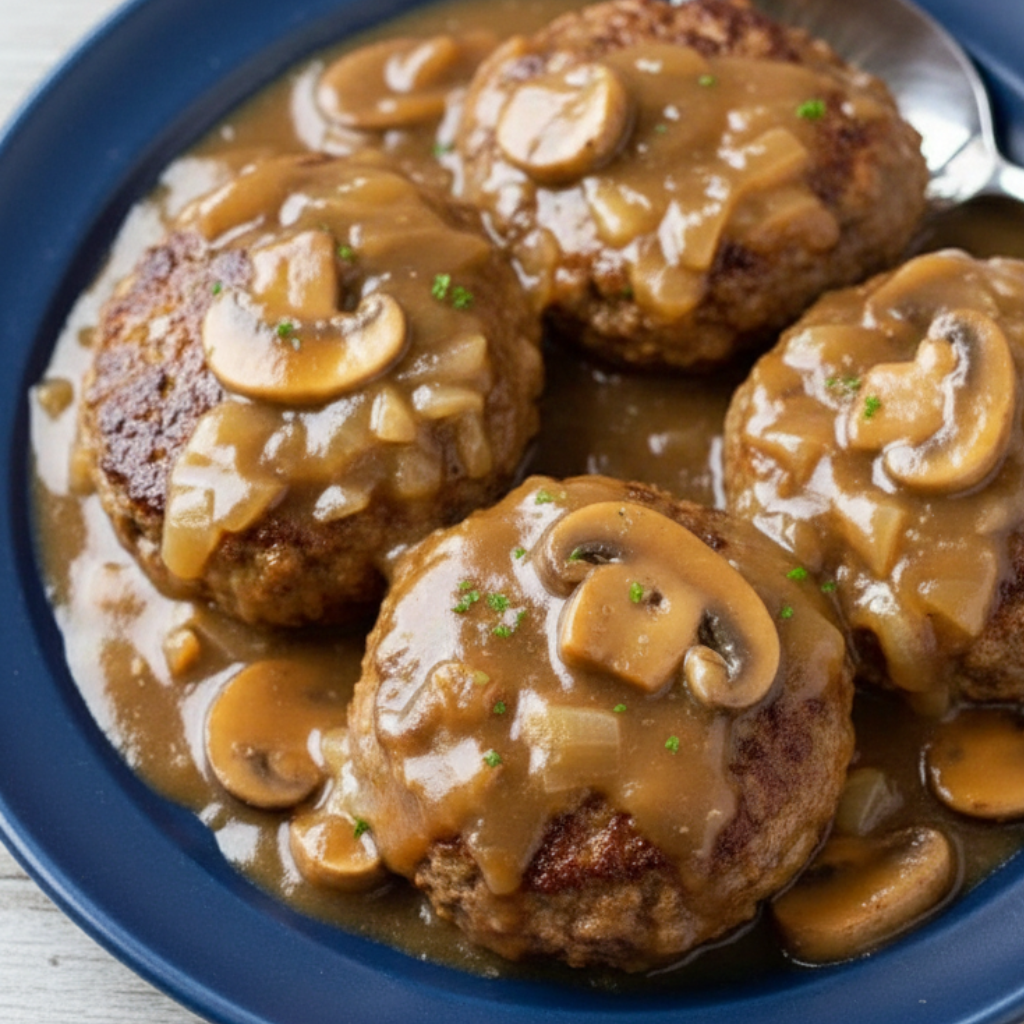
Salisbury steak has a reputation problem. For a lot of people, the first image that comes to mind is a grey, rubbery frozen dinner swimming in watery brown sauce. That version and this version are barely related. Made from scratch with a proper panade worked into the beef and a rich mushroom gravy built right in the same pan, salisbury steak is one of the most satisfying, genuinely comforting dinners you can put on the table on a weeknight.
This is the kind of food that appeals to every person at the table without exception. It is budget-friendly, uses ingredients you almost certainly already have, and it holds up beautifully as leftovers. The mushroom gravy alone is worth making this recipe for.
What Makes Salisbury Steak Different From a Burger Patty
It Is Closer to Meatloaf Than You Think
A lot of people treat salisbury steak and hamburger steak as interchangeable, but there is a meaningful difference in how they are made. A hamburger steak is essentially a formed ground beef patty seasoned simply, closer in spirit to a hamburger. Salisbury steak is built with a panade, which is the mixture of liquid and starch that binds and tenderizes the meat. Add an egg as a binder, some breadcrumbs, milk, and seasoning, and what you end up with is something that sits much closer to an individually portioned meatloaf than a burger, with a noticeably different texture.
A Little History Worth Knowing
Salisbury steak gets its name from James H. Salisbury, a nineteenth-century physician who invented the dish in 1888. His reasoning was unconventional, to say the least. He believed that people should eat mostly meat and keep vegetables and starches to a minimum, and he promoted this particular beef preparation as something that could be consumed multiple times a day. The dish clearly outlasted the diet philosophy behind it.
The Panade: What Keeps Everything Juicy
Why It Matters
The single most important technique in this recipe is the panade, and understanding what it does makes it easier to get right. When meat cooks, the proteins contract and squeeze out moisture. A panade, which here is a mixture of breadcrumbs, milk, egg, and seasonings blended into a paste, physically interrupts that process. The starch from the breadcrumbs turns into a gel as the meat heats up, and that gel holds onto moisture inside the patty, keeping it tender and juicy all the way through rather than drying out during the time it spends in the pan.
Getting the Mix Right
The panade ingredients come together first before any beef is added. Whisk the egg with the milk, mustard, ketchup, Worcestershire sauce, oregano, salt, and pepper, then stir in the breadcrumbs until it forms a thick paste. The cooked, cooled onions and garlic go in at this stage too. Once it looks like a paste rather than a loose liquid, it is ready to be worked into the beef.
This is where a lot of people go wrong: they overmix. Once the panade and the beef are in the bowl together, you want to combine them with your hands until just mixed, meaning no streaks of panade visible, but the moment it looks uniform, you stop. Overworked ground beef gets dense and tough as it cooks, and there is no recovering from that once it happens.
Building the Beef Patties
Sautéing the Onion and Garlic First
Technically optional, but worth doing: cooking the minced onion and garlic in a little olive oil before adding them to the panade gives them a more mellow, integrated flavor and texture inside the finished patties. Raw onion in a meat mixture can stay sharp and a little crunchy, which most people find distracting, particularly if you are cooking for anyone who tends to pick out onion pieces. Five minutes over medium heat is all they need. Let them cool before adding them to the panade so they do not start cooking the egg.
Shaping and Chilling
Divide the mixture into four equal portions and form each one into an oval patty roughly three quarters of an inch thick. Oval is the traditional shape for salisbury steak, and it is also practical: the elongated shape means more surface area makes contact with the hot pan, which means better browning.
Once shaped, refrigerate the patties for about fifteen minutes before searing. This brief chill firms up the mixture and significantly reduces the chance of them cracking or falling apart when you flip them. It is a small step that saves a lot of frustration.
Searing the Patties the Right Way
Why You Only Brown Them at This Stage
Get a large skillet hot with two tablespoons of olive oil over medium-high heat and sear the patties two at a time, about one minute per side. The pan needs to be genuinely hot before the beef goes in, otherwise the patties will steam and stick rather than forming a proper crust.
At this point the middles will still be raw, and that is exactly right. The sear is about creating a browned exterior that adds flavor and helps the patties hold their shape. They will finish cooking completely when they are added back to the gravy later and covered. Trying to cook them all the way through at this stage before the gravy is ready will result in overcooked, dry patties by the time the dish is done.
Use a spatula wide enough to fully support each patty when lifting and flipping. A spatula that is too small will cause the patty to bend and potentially split down the middle.
Making the Mushroom Gravy
Starting the Base
In the same skillet the patties were seared in, add a tablespoon of olive oil and sauté the diced onion for about five minutes until softened. The browned bits left in the pan from the beef will loosen and blend into the gravy base, adding depth you would not get if you started with a clean pan. Add a tablespoon of butter along with the sliced mushrooms and cook for another five minutes until the mushrooms are golden and have released most of their moisture.
Adding the Liquid and Seasonings
Pour in the beef broth and add the beef bouillon cube, onion powder, garlic powder, and Worcestershire sauce. Stir everything together and bring the liquid up to a boil. The bouillon is worth including even though you are already using broth: it intensifies and rounds out the beef flavor in a way that broth alone does not quite achieve.
Thickening the Gravy
To thicken, whisk three tablespoons of cornstarch into a quarter cup of cold water until completely smooth, then pour the slurry slowly into the boiling gravy while whisking continuously. The key here is cold water: cornstarch clumps instantly in hot liquid, so mixing it with cold water first ensures it disperses evenly. Add the slurry gradually and stop when the gravy reaches the consistency you want. You may not need all of it.
If you prefer to thicken with a roux instead, melt two tablespoons of butter into the pan after the mushrooms are cooked, whisk in two tablespoons of flour, and cook that mixture for a full minute to get rid of the raw flour taste before adding the broth. Both methods work well; the slurry is quicker and the roux gives the gravy a slightly richer, more velvety body.
Salisbury Steak Recipe
Ingredients
Equipment
Method
- Cook the Onion and Garlic Heat 1 tablespoon of olive oil in a large skillet over medium heat. Add the minced onion and garlic and sauté for about 5 minutes until softened. Remove from the pan and set aside to cool completely. This step is optional but gives the patties a more subtle, integrated flavor.
- Make the Panade In a large bowl, whisk together the egg, milk, mustard, ketchup, Worcestershire sauce, oregano, salt, and pepper. Stir in the breadcrumbs and continue stirring until the mixture forms a paste. Add the cooled onion and garlic and stir to combine.
- Mix the Beef Add the ground beef to the bowl with the panade. Use your hands to mix until just combined, stopping as soon as the mixture is uniform. Do not overmix or the patties will be tough.
- Shape and Chill Divide the mixture into 4 equal portions and form each into an oval patty about 3/4 inch thick. Place them on a plate, cover, and refrigerate for 15 minutes to help them hold their shape during cooking.
- Sear the Patties Heat the remaining 2 tablespoons of olive oil in the same skillet over medium-high heat. Sear the patties two at a time for 1 minute per side until browned on the outside. Remove and set aside. The centers will still be raw at this point.
- Build the Gravy Add 1 tablespoon of olive oil to the same skillet over medium heat. Sauté the diced onion for 5 minutes. Add the butter and sliced mushrooms and cook for another 5 minutes until the mushrooms are golden.
- Add the Liquid Pour in the beef broth and add the bouillon cube, onion powder, garlic powder, and Worcestershire sauce. Stir to combine and bring the gravy to a boil.
- Thicken the Gravy Whisk the cornstarch into the cold water until smooth. Slowly pour the slurry into the boiling gravy while whisking continuously, adding only as much as needed to reach your desired consistency. Reduce the heat to medium.
- Finish Cooking the Steaks Return the seared patties to the skillet and spoon the gravy over the top. Cover and cook over medium heat for 10 to 15 minutes, until the internal temperature of the patties reaches 160 degrees Fahrenheit.
- Serve Spoon generously with mushroom gravy and serve over mashed potatoes or alongside buttered egg noodles.
Notes
- Chilling the shaped patties before searing is important for keeping them intact when handled and flipped. Do not skip this step.
- Use a wide spatula large enough to fully support each patty so it does not crack or break when being moved.
- Sear only two patties at a time so the pan stays hot enough to brown rather than steam.
- The mushrooms and onions in the gravy can be left out if preferred. The gravy will still have excellent flavor.
- To thicken with a roux instead of a cornstarch slurry: after cooking the mushrooms, melt 2 tablespoons of butter in the pan, whisk in 2 tablespoons of flour, cook for 1 minute, then slowly add the broth while whisking continuously.
- Raw shaped patties can be refrigerated overnight or frozen for up to 3 months. Thaw in the refrigerator overnight before cooking.
- Leftovers keep refrigerated in an airtight container for up to 3 days or frozen for up to 3 months. Reheat gently on the stovetop with a splash of broth if the gravy has thickened.
Finishing the Dish
Once the gravy is thickened, reduce the heat to medium and nestle the seared patties back into the pan. Spoon the gravy generously over the top, put a lid on the skillet, and let everything cook together for ten to fifteen minutes. The patties finish cooking through in the gravy during this time, absorbing some of the flavor as they do.
The steaks are done when an instant-read thermometer inserted into the center reads 160 degrees Fahrenheit. This is the safe internal temperature for ground beef, so it is worth checking rather than going by time alone, since pan size and patty thickness can both affect how long this stage takes.
Troubleshooting Common Issues
The Patties Fell Apart While Searing
This usually comes down to one of two things: the mixture was not chilled before searing, or the pan was not hot enough when the patties went in. A cold patty holds its shape better under the initial heat, and a properly hot pan creates an immediate crust that locks the patty together from the outside. If the oil is not shimmering before the beef goes in, wait a little longer.
The Gravy Is Too Thin
Add a little more cornstarch slurry, making sure to whisk it into cold water first, then stir it into the simmering gravy and give it a minute to thicken. Gravy thickened with cornstarch continues to thicken slightly as it cools, so factor that in if you are aiming for a specific consistency.
The Gravy Is Too Thick
A splash of warm beef broth stirred in will thin it back to the right consistency without diluting the flavor significantly. Add it a little at a time so you do not overshoot.
Variations Worth Trying
Without Mushrooms
The mushrooms add an earthy, savory character to the gravy that works beautifully here, but they are genuinely optional. If you are cooking for picky eaters or simply do not have mushrooms, leave them out entirely and the gravy is still excellent. You can double the onion quantity to compensate for the volume the mushrooms would have contributed.
Swapping the Protein
Ground turkey works as a substitute for beef if you want something leaner. The flavor will be milder, so consider bumping up the Worcestershire sauce and adding a touch more seasoning to the panade to compensate. The texture will be slightly different but the dish still holds together well.
What to Serve Alongside
Creamy mashed potatoes are the ideal base for salisbury steak and mushroom gravy. The gravy soaks into the potatoes in a way that makes the whole plate feel like one cohesive dish. Buttered egg noodles are another excellent option and come together faster. For vegetables, roasted green beans, a simple corn side, or green bean casserole all complement the richness of the gravy without competing with it. Buttermilk biscuits on the side for sopping up extra gravy is never a bad decision.
Making It Ahead and Storing
Prep Ahead
The patties can be shaped the night before and refrigerated overnight, covered. This actually works in your favor because the extra resting time firms the mixture further and makes the patties even easier to handle when it is time to sear. For longer make-ahead planning, the shaped raw patties freeze well for up to three months. Wrap each one individually in plastic wrap, store in a freezer bag, and thaw overnight in the refrigerator before cooking.
Storing Leftovers
Leftovers keep in an airtight container in the refrigerator for up to three days. The patties sitting in the gravy overnight actually taste better the next day as the flavors continue to meld. Reheat gently over low heat on the stovetop, adding a splash of broth if the gravy has thickened up too much in the fridge. The dish also freezes well for up to three months in a freezer-safe container.
Hi, I’m Josie Erin. At TheRecipeBites, I turn simple, everyday ingredients into flavorful bites that make every meal memorable. I believe great food doesn’t have to be complicated it just needs the right balance of flavor, creativity, and love. From quick weeknight dinners to sweet treats worth sharing, I’m here to help you cook with confidence and enjoy every bite.